
Finding the perfect pair of jeans is often described as one of the most frustrating shopping experiences in modern fashion. You spend hours in fitting rooms, trying on countless pairs, only to find that the pair fitting perfectly over your hips and thighs leaves a massive, gaping space at the lower back. This common dilemma leads to a highly searched question across the UK: can jeans be taken in at the waist?
The short answer is a resounding yes. However, denim is a notoriously difficult fabric to work with. Unlike standard trousers or a delicate dress, denim requires heavy-duty machinery, specialised needles, and specific topstitching thread to maintain its original aesthetic. In this comprehensive guide, we will explore everything you need to know about tailoring denim, how the professionals eliminate the dreaded waist gap, and how you can seamlessly transform your ill-fitting jeans into a custom-tailored masterpiece using the iSeam.uk platform.
The Denim Dilemma: Why Jeans Rarely Fit Perfectly Off the Rack
To understand why you need alterations, it is important to understand how mass-market denim is produced. High street brands and designer labels design their jeans based on standard, homogenised fit models. These sizing blocks are created using mathematical averages of body proportions. The problem? Human bodies are remarkably diverse, and very few people perfectly match these mathematical averages.
For individuals with an hourglass or pear-shaped figure, or anyone with a higher waist-to-hip ratio, buying jeans to fit the widest part of the body (usually the hips or thighs) inevitably results in excess fabric at the waist. If you try to size down to fit the waist, the jeans become uncomfortably tight—or entirely unwearable—across the lower half.
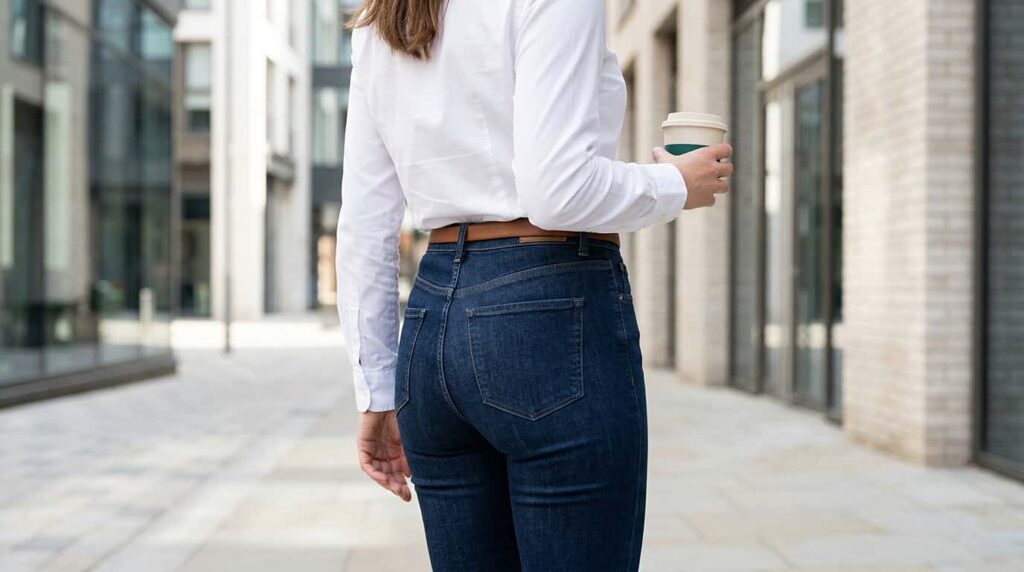
This excess fabric at the back of the waistband is universally known as the “waist gap.” Not only does it look untidy, but it also causes the jeans to slide down throughout the day, requiring constant readjustment or the use of an uncomfortable, tightly cinched belt that bunches the fabric. The most effective, permanent solution is professional tailoring.
Can Jeans Really Be Taken In? (And What Are the Limits?)
While the answer is yes, there are technical limits to how much a waist can be reduced before the fundamental structure and aesthetic of the jeans are compromised.
As a general rule within the tailoring industry, a denim waistband can be successfully taken in by up to 2 to 3 inches (approx. 5 to 7.5 centimetres). Altering within this range allows the tailor to maintain the original proportions of the jeans.
If you attempt to take a waistband in by more than 3 inches, several issues begin to arise:
- Back Pocket Placement: The rear pockets will be pulled too close together, sitting unnaturally near the centre seam, which distorts the rear aesthetic of the jeans.
- Side Seam Distortion: Taking too much fabric from the centre back can cause the side seams to twist forward, completely ruining the drape of the legs.
- Belt Loop Crowding: The belt loops at the back will end up practically touching each other.
If your jeans are more than three sizes too big at the waist, it may require a complete recut of the Tailoring Item, which is highly complex and often not cost-effective. However, for the standard 1 to 3-inch waist gap, professional alteration is a standard and highly successful procedure.
How Professional Tailors Fix the Waist Gap
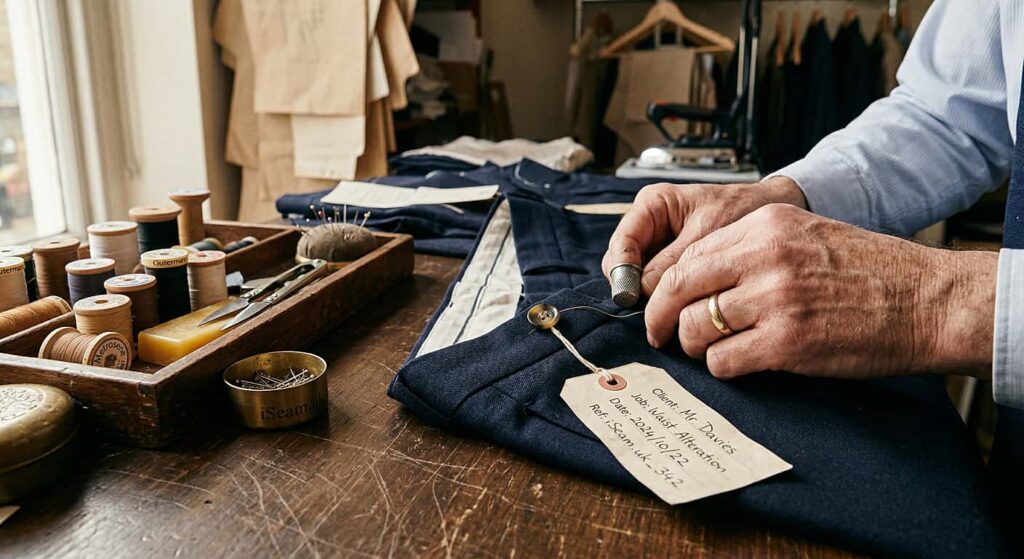
When you submit your Tailoring Item to a professional, they generally employ one of two methods to reduce the waist, depending on the severity of the gap and the construction of the denim.
Method 1: The Darting Method
Darting involves pinching the excess fabric at the back of the jeans (usually directly above the rear pockets) and sewing a tapered seam down into the yoke. This method is generally reserved for minor adjustments—usually taking in 1 inch or less.
Pros: It is less invasive, requires less deconstruction of the original jeans, and is generally a faster alteration.
Cons: Darts are visible. While a skilled tailor will blend them seamlessly, you will have two new, small seams at the back of your jeans. This method is less suitable for heavily washed or distressed denim, as the newly folded fabric will interrupt the fade patterns.
Method 2: Waistband Removal and Centre Back Seam Alteration
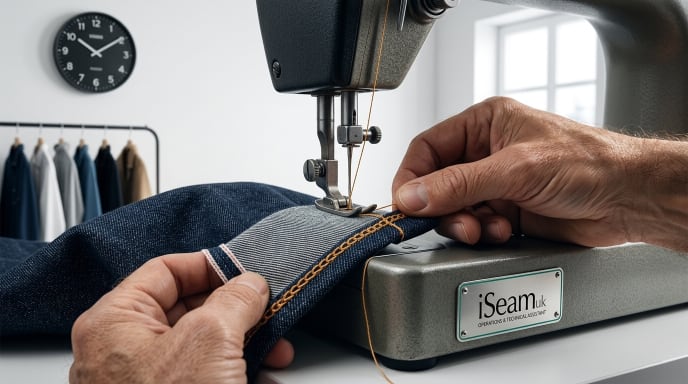
This is the gold standard for denim alterations and the technique most commonly used by expert tailors on the iSeam.uk platform. It is a highly technical process that involves practically rebuilding the upper half of the jeans.
- Deconstruction: The tailor carefully unpicks the heavy topstitching at the centre back of the waistband and removes the central belt loop. They will detach the waistband from the main body of the jeans just past the side seams.
- Adjusting the Yoke and Seat: The tailor then opens the centre back seam (the seam running down the middle of the bottom) and takes out the excess fabric. This ensures the jeans taper naturally into the newly sized waist, maintaining a smooth curve over the lower back.
- Resizing the Waistband: The removed section of the waistband is cut down to match the new, smaller circumference. A new seam is created to join the waistband back together.
- Reconstruction: The newly sized waistband is securely sewn back onto the jeans. The tailor will use heavy-duty denim thread perfectly matched to the original topstitching colour (often a distinct gold or copper). Finally, the central belt loop is reattached to hide the new seam on the waistband.
When done correctly, this method is practically invisible. Your Tailoring Item will look exactly as it did when you bought it, but it will finally fit your body perfectly.
Other Essential Denim Alterations You Should Consider
Taking in the waist is just one way to achieve the perfect fit. When considering sending a Tailoring Item to a professional, you might want to look at other aspects of the jeans.
Shortening Jeans While Keeping the Original Hem
Standard trousers are easy to hem; you simply fold the fabric up and sew it. Denim, however, features a distinct, distressed edge at the hem caused by the industrial washing process during manufacturing. If a tailor simply cuts and folds the denim, you lose that beautiful, rugged edge, and the jeans can look distinctly homemade or artificially shortened.
A professional tailor will perform a “Euro Hem” (also known as an original hem or a trifold hem). They will cut the jeans to the desired length, remove the distressed hem from the discarded fabric, and meticulously reattach it to the newly shortened leg. This preserves the authentic look of the jeans perfectly.
Tapering the Legs
Vintage jeans and straight-leg styles are incredibly popular, but sometimes they feature too much volume from the knee down. A tailor can open the inseam or outseam and taper the legs, transforming a baggy, dated pair of jeans into a sleek, modern, slim-fit silhouette.
Hardware Replacement and Repairs
A broken zip or a popped rivet does not mean your favourite jeans belong in the bin. Replacing a heavy-duty denim zip requires specialised equipment, but it is a standard job for a professional. Similarly, reinforced darning can repair tears in the thighs or knees, extending the life of your jeans by years.
DIY Denim Alterations vs. Professional Tailoring
With thousands of tutorials available online, it can be tempting to attempt a waist alteration yourself using a standard domestic sewing machine. However, denim presents unique challenges that make DIY alterations highly risky.
- Thickness of Fabric: The intersection where the waistband meets the centre back seam and the belt loop can contain up to eight layers of thick denim. A standard domestic sewing machine simply lacks the motor power to punch through this. Attempting to do so will almost certainly result in snapped needles, jammed machines, and uneven, messy stitching.
- Thread Matching: Finding the exact gauge and colour of industrial topstitching thread used by denim manufacturers is difficult for a home sewer. Using standard polyester thread will result in weak seams that are prone to bursting under pressure.
- The Risk of Ruin: If you cut into the fabric incorrectly, or alter the yoke at the wrong angle, the jeans will sit unevenly. Once the fabric is cut, there is no going back, and you risk completely ruining your Tailoring Item.
Professional tailors possess industrial-grade walking-foot sewing machines designed specifically for heavy canvas and denim, alongside an extensive inventory of matching threads and hardware. When it comes to denim, relying on an expert is an investment in the longevity of your clothing.
How iSeam.uk Makes Denim Alterations Effortless
Historically, finding a reputable tailor required taking time out of your busy day, traveling to a high street shop, enduring an awkward fitting session, and haggling over opaque pricing. iSeam.uk has completely modernised this process, providing a seamless, stress-free marketplace for all your alteration needs.
Our fixed-price online platform operates on a brilliantly simple, end-to-end workflow designed for your convenience:
- Customer Orders Online: Browse our transparent, fixed-price service menu. Select the specific denim alteration you need, such as “Take In Waist,” and pay upfront via our secure platform. There are no hidden fees or surprise upcharges.
- Tailor Accepts: Your job is instantly broadcast to our network of vetted, professional tailors across the UK. A qualified tailor accepts your job on a first-come, first-served basis.
- Item Shipped: You securely package your jeans and ship the Tailoring Item directly to the designated tailor using tracked delivery.
- Work Completed: The tailor receives your Tailoring Item and performs the precision alterations using industrial equipment.
- Item Returned: Once completed, the tailor carefully packages your jeans and ships the Tailoring Item straight back to your door, ready to wear.
This streamlined process means you can achieve bespoke, perfect-fitting denim without ever leaving your home.
Preparing Your Tailoring Item for Alteration
Before you ship your jeans to an iSeam professional, there are two crucial steps you must take:
1. Wash and Dry Your Jeans: Denim, particularly raw or unwashed denim, is highly susceptible to shrinkage. If you send brand new jeans to be altered, and then wash them for the first time afterwards, they may shrink and become too small. Always wash and dry your Tailoring Item according to the care label before sending it in.
2. Pinning or Measuring: For a waist alteration, you need to clearly communicate how much fabric needs to be removed. Put the jeans on, pinch the excess fabric at the centre of the back waistband until the jeans fit comfortably, and secure it with a safety pin. Alternatively, measure the pinched amount with a tape measure and provide this measurement (in inches or centimetres) in the notes section when booking your service on iSeam.uk.
Frequently Asked Questions (FAQ)
Can you make jeans bigger at the waist?
This is much more difficult than taking them in. Manufacturers do not leave excess fabric (seam allowance) inside denim seams. To let the waist out, a tailor must add an expansion panel—usually a V-shaped gusset of matching denim or elastic—into the side seams or back waistband. While functional, it is highly visible.
Will the tailor use matching thread?
Absolutely. Professional tailors working through the iSeam.uk platform stock a vast array of industrial topstitching threads to match the iconic gold, copper, or navy threads used by leading denim brands, ensuring the alteration is as invisible as possible.
Are stretch jeans altered differently than 100% cotton jeans?
The methodology (removing the waistband and taking in the centre seam) remains the same. However, stretch denim containing elastane requires the tailor to use a slightly different tension on their sewing machine to prevent the seams from puckering or snapping when the jeans stretch over your body.
How long does the alteration process take?
By utilising the iSeam.uk marketplace, the process is highly efficient. Once your Tailoring Item is received by the tailor, the physical work is usually completed within a few working days, before being immediately shipped back to you via tracked delivery.
Is it worth altering cheap jeans?
This comes down to personal preference and sustainability. Fast-fashion jeans might be inexpensive, but if they fit poorly, they will likely sit unworn in your wardrobe. Investing in a fixed-price alteration transforms an unwearable item into a wardrobe staple, reducing textile waste and providing you with a custom fit that looks far more expensive than the original price tag.
Conclusion: Say Goodbye to the Waist Gap
You do not have to settle for jeans that gap at the back or slide down your hips. Taking in the waist of denim is a standard, highly effective procedure when performed by an expert with the right equipment. By trusting the professionals on the iSeam.uk platform, you ensure your garments are handled with care, precision, and expertise.
Ready to finally experience the perfect fit? Browse our fixed-price tailoring services, book your alteration online today, and let our network of UK professionals transform your Tailoring Item.